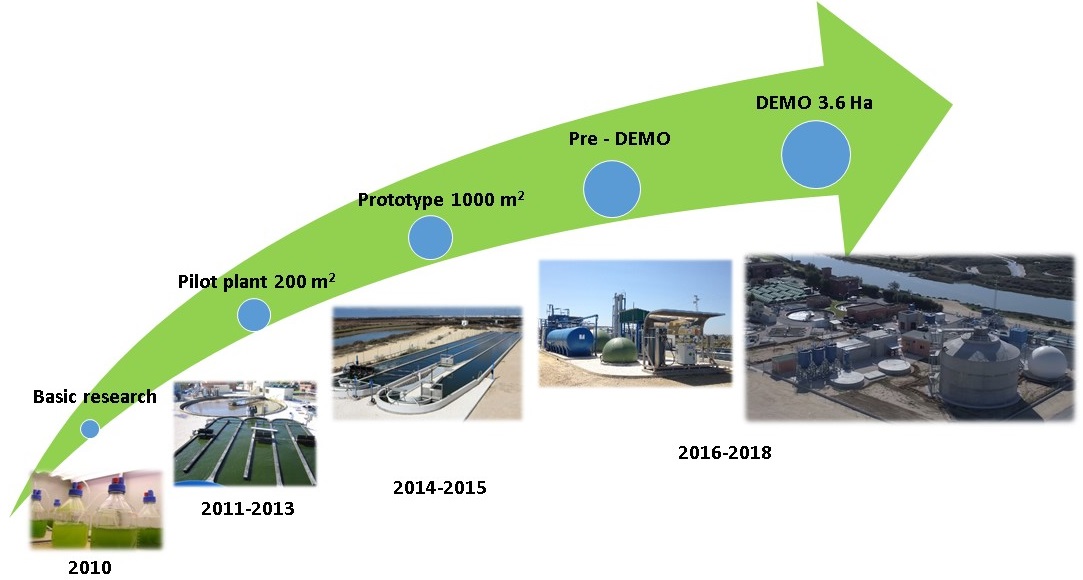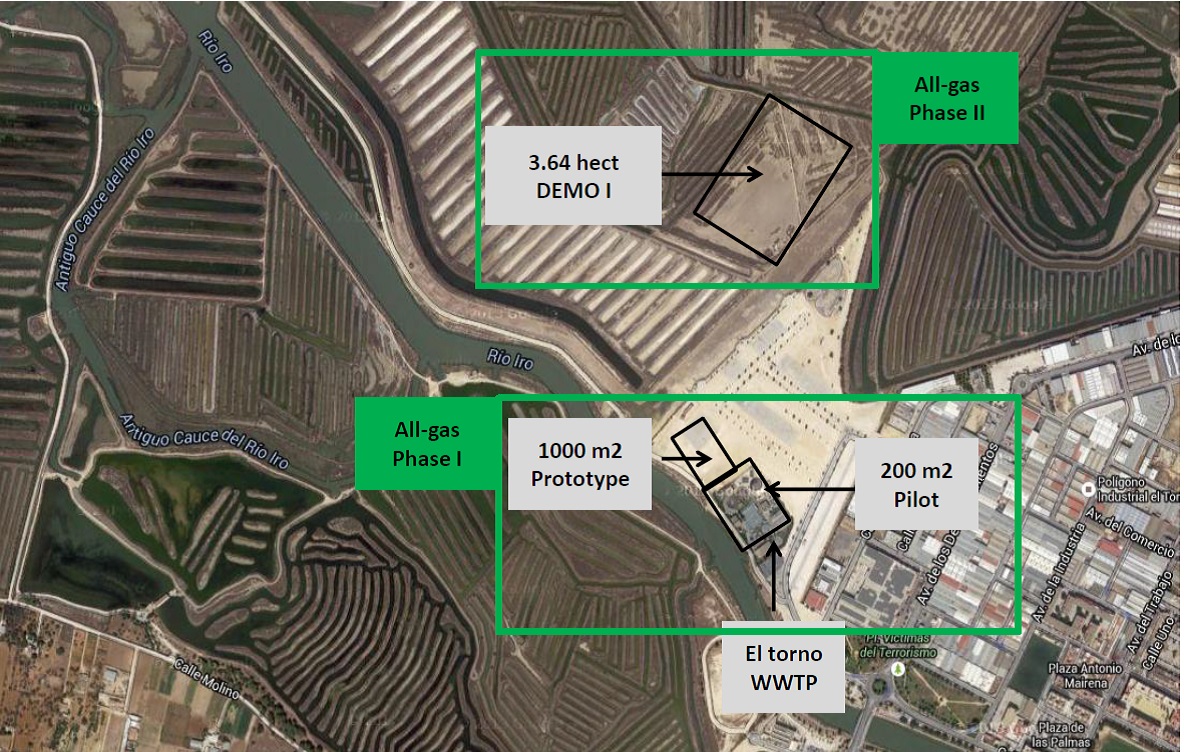
Objectives and Challenges
- Integrate the full production chain of algae to biofuels, using wastewater nutrients and residual biomass energy and CO2 as main inputs.
- Demonstrate that, using an innovative pond enhancement, the algae culture up to 10 ha can have a yield of biomass production close to 100 ton/ha/yr.
- Harvest and transform the algae biomass for the production of biodiesel to feed an engine test bed, and evaluate the extraction of some additional chemicals by innovative methods to obtain value-added chemicals with known markets.
- Implement a new concept for co-digestion of about 5000 m3/d of wastewater, together with algae residue, as well as other extraction by-products, to produce CH4 and CO2.
- Upgrade the biomethane for vehicle fuel to power up to 200 cars.
- Obtain the necessary CO2 to reach the enhanced algal yield from gases of external biomass combustion (i.e, sludge from a wastewater treatment plant located in the area), together with internal biomass combustion (digestate from residual algae and wastewater solids), or other agricultural residues.
- Take advantage of the thermal energy from biomass combustion gases for drying and/or generate electricity to power the system.
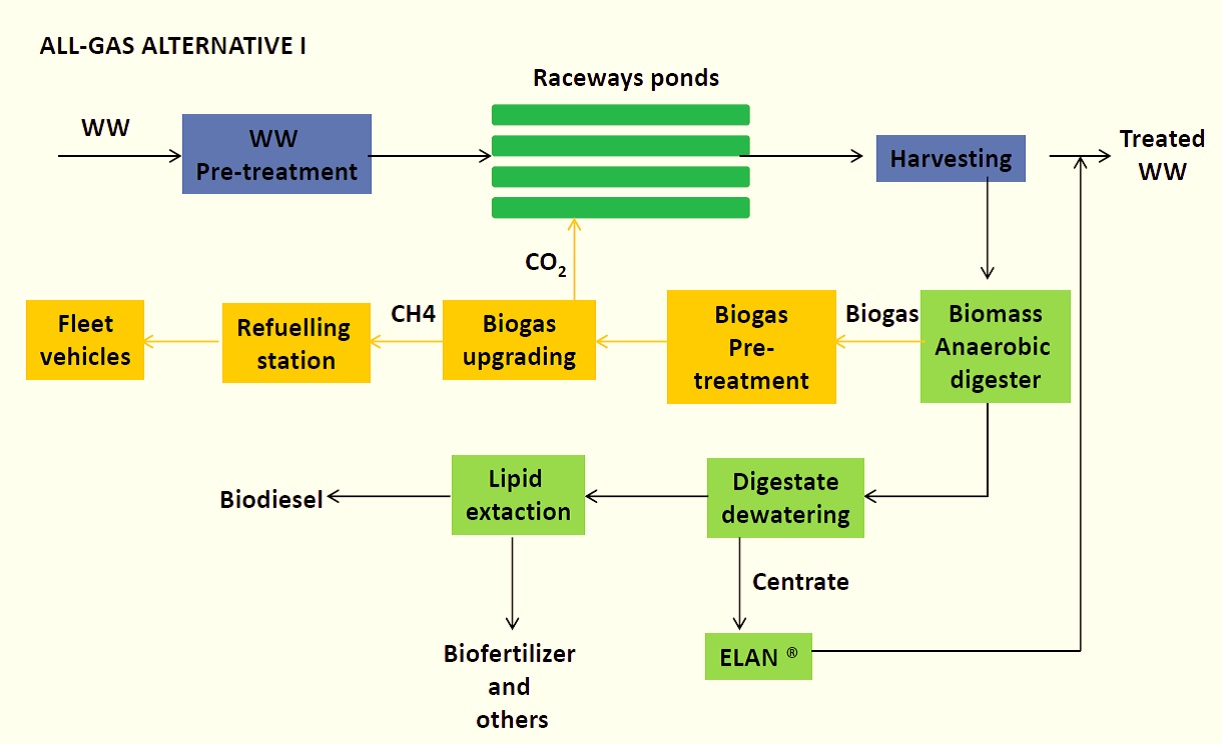
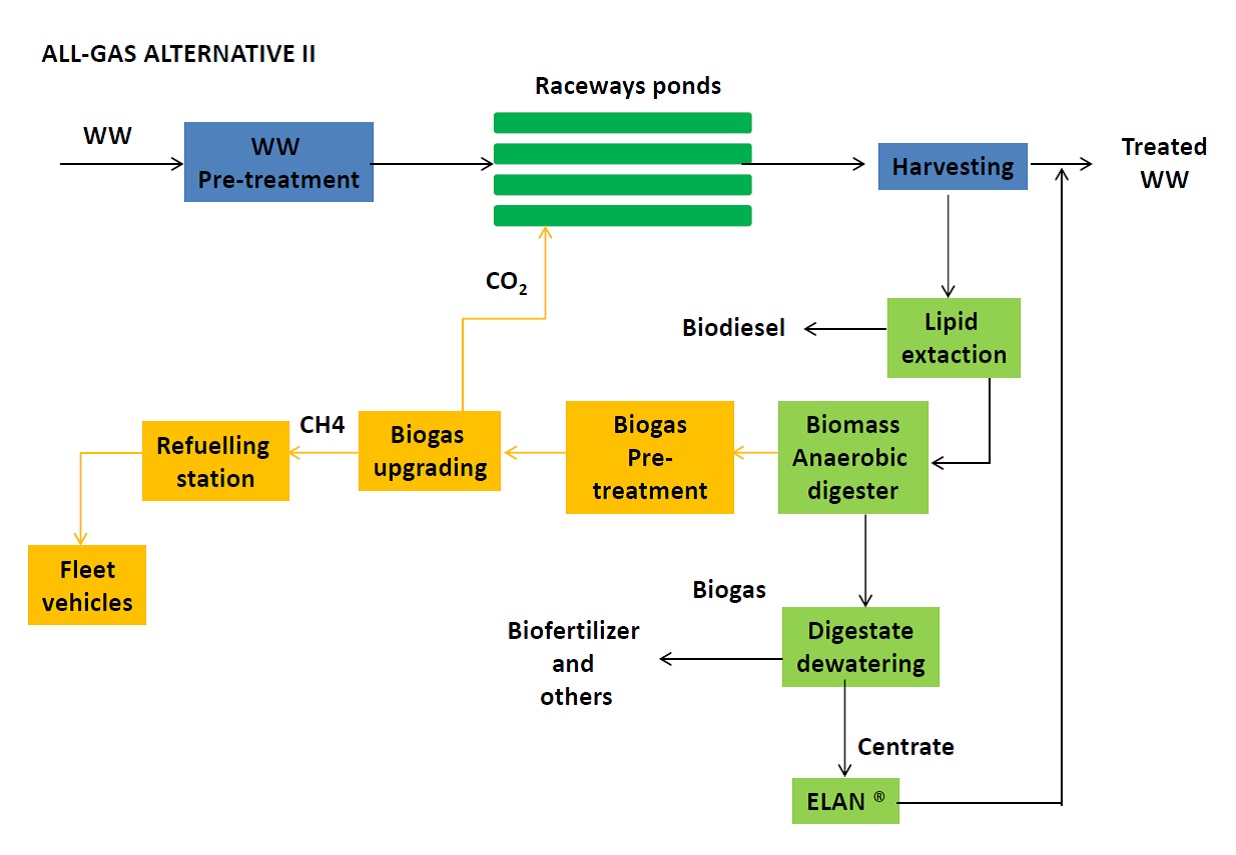
Simplified All-gas flow diagrams; Alternative I: Post lipid extraction and Alternative II: pre lipid extraction.
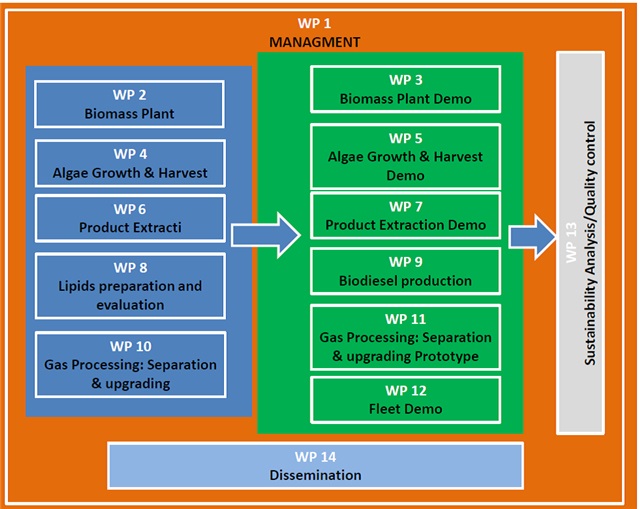
Work Packages
Advisory board
John Benemann
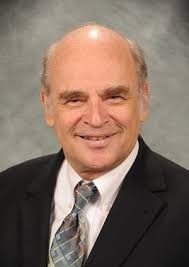
John holds a B.S. in Chemistry and a Ph.D. in Biochemistry, both from the U.C. Berkeley. He spent three years as postdoctoral fellow at the Deptartment of Chemistry at U.C. San Diego; then rejoined U.C. Berkeley in the Department of Civil Engineering, where, as an independent researcher, he supervised half a dozen Ph.D. thesis students in Civil Engineering, Biophysics and Plant Physiology. From 1983 to 1988, John was an Associate Professor in the Department of Applied Biology at the Georgia Institute of Technology, where he also supervised Ph.D. and M.S. theses in Chemical Engineering. Dr. Benemann is probably the world’s most sought-after algae consultant. He advises many Fortune 100 corporations in the US and abroad on algae technology and algae business matters.
Tryg Lundquist
With two decades of research and engineering practice, Dr. Tryg Lundquist, P.E. is one of the most experienced algae wastewater treatment engineers in the world. An Assistant Professor of Civil and Environmental Engineering at the California Polytechnic State University, San Luis Obispo, he was a long-time protégé of the late Professor William Oswald of U.C. Berkeley, the pioneering developer of the modern raceway pond process for wastewater treatment and high-value algae production. Dr. Lundquist has developed crucial improvements in algal wastewater treatment and expanded its application into treatment of agricultural drainage and the toxic metalloid, selenium. He has participated in the design, construction, and operation of full-scale municipal high rate pond facilities.
Emilio Molina Grima
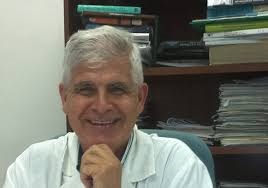
He is the Chair of the Group of Biotechnology of Marine Microalgae in the University of Almería. He coordinated a multinational European Project on the production and processing of lipids from algae, and participated in four others; and coordinated several national R&D ones. He received the Scientific and Technological research prize of Almería Province in 2004 and his group was awarded in February of 2008 by the Mediterranean Foundation for their contribution in Biotechnology Research and Collaboration with Biotech companies.
Charles Banks
Prof. Charles Banks is Professor within Engineering and the Environment at the University of Southampton. Research interests are in the area of innovative technology for environmental protection Current research projects reflect these interests and have led to the design of novel reactor systems and operating protocols to meet the challenges of new and adapted technologies for environmental protection, renewable energy production and sustainable nutrient management systems. Of special interest is the development of operating protocols for anaerobic digestion, to maximise rates of substrate conversion and biogas yield. As part of this, current research is promoting the use of mass and energy balances as a means of quantifying process performance and developing new analytical tools to broaden our understanding of the process, its kinetics and limitations. Earlier research on wastewater treatment systems based on algal photosynthesis is now linking together with some existing themes including growth of algal biomass for energy production and product generation in biorefineries: this encompasses work on reactor design and biochemical pathways.
Rupers Craggs
Rupert is a Principal Scientist and Manager of NIWA's Aquatic Pollution Group based in Hamilton, New Zealand. He has specialized in resource (energy, nutrient and water) recovery from wastewater using natural wastewater treatment systems. His research has involved: evaluation, optimisation, design, engineering and construction of ponds, raceways, filters, and scrubbers for wastewater treatment; optimising natural nutrient removal and disinfection processes; and control of midge nuisance and odour release from conventional wastewater treatment ponds. His energy related research has developed Covered Anaerobic Ponds for enhanced biogas production in simple, cost-effective ponds; and wastewater treatment High Rate Algal Ponds with CO2 addition for production of algal biomass for use as fertiliser, feed, or conversion to biofuel. Rupert currently leads two MSI research programmes on energy recovery and biofuel production using enhanced wastewater treatment ponds.
Scale up