

About us
FCC Aqualia, S.A. is the water management parent company of FCC, one of the largest European services groups. aqualia responds to the needs of all parties, private and public, at all stages of the water cycle, providing water for human, industrial, and agricultural uses. Its main activity is the management of municipal water services.
In a short space of time aqualia has positioned itself as a leader in the sector, a cohesive, specialist operator at the forefront of the sector thanks to a highly-specialised and committed team that is constantly seeking new ways to improve efficiency in production processes and optimise resources.
This modus operandi, which has enabled aqualia to consolidate itself as leader in the domestic market, is also apparent in export markets, with a strategy formulated to consolidate ambitious but prudent growth overseas.
History
With 34% of the Spanish indirect water management market, aqualia is present in more than 1,100 municipalities and provides services to more than 28,000,000 people worldwide.
The presence of aqualia throughout Spain demonstrates the ability of the company to adapt to different social and technical realities.
In Spain, aqualia provides services to more than 850 municipal councils. Notable examples of its management and provision of potable water and sanitation services.
In 2010, aqualia became the largest integral water cycle management company in Spain. The boost to the growth of its international business (with the securing of new contracts) and the reinforcement of its diversification strategy were two key factors in 2009.
What people say
A unique perspective on water management.
aqualia's main objective is to ensure the provision of the best possible water quality in sufficient quantities.
aqualia Strategic Quality Plan
Our technology
DRINKING WATER
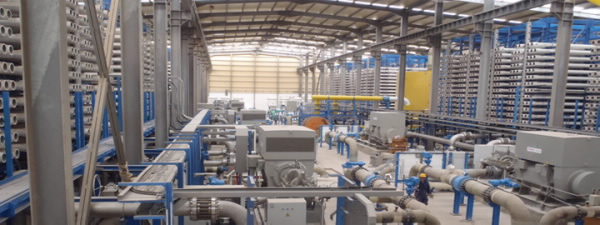
The design, technology and construction of plants for the treatment of potable and waste water and desalination, which aqualia performs through its subsidiary aqualia infraestructuras, which specialises in the design and construction of potable water treatment plants, waste water treatment plants, water reuse plants and desalination plants.
DESIGN
Due to its structure, technological development and experience in project management and excellent quality of service, aqualia infraestructuras is considered a benchmark in the sector around the world. Its has reference projects across Spain and in countries such as Algeria, Egypt, the Czech Republic and Mexico. Its capacity and flexibility allow aqualia infraestructuras to provide solutions from the beginning to the end of a project.
About us
KMS is your strategic partner in an evolving global marketplace.
Every day, we help thousands of companies like yours reduce their water footprint, increase productivity, and lower operating expenses. And we’re helping millions of people live healthier lives by developing better ways to purify the world’s water sources, improve food processing, and more.
Our engineers have a long history of developing revolutionary technologies and bringing creative and innovative products to market that have superior functionality and efficiency that mean long-term financial benefits for you.
When you partner with us, you’ll get the business advantages of our industry knowledge, selection of specialized products, design expertise, and system commissioning. Most of all, you’ll benefit from our deep commitment to excellent service. We enjoy solving your most pressing challenges with smart, reliable, cost-effective solutions.
As your strategic partner, our goal is to discover new and better ways to help you create value. We welcome your input, because the needs of our clients drive some of our best innovations.
History
See what half a century of innovation looks like.
The Early Years
Koch Membrane Systems, Inc. was established in 1963 as a privately held company known as Abcor, Inc. Its charter was to develop and commercialize processes and equipment based on separation and purification technologies, which originated with scientists from the Massachusetts Institute of Technology.
The Shift In Focus
In 1970, the company added ultrafiltration membranes and systems to its portfolio of separation technologies, which proved to be so successful that all other separation technologies were abandoned. Since then, the company has concentrated entirely on membrane separation and has become a world leader in this field.
The Evolution
The growth of our original company was gradual but well focused. Koch Engineering Company, recognizing the commercial potential of these technologies at the outset, not only provided the seed capital to establish Abcor, but obtained minority ownership position. In 1977, Koch Engineering Company bought out the remaining shares, with Abcor becoming a wholly owned subsidiary. In 1981, the company became Koch Membrane Systems, Inc.
A Global Community
KMS is headquartered in Wilmington, Massachusetts, with offices throughout the world. With manufacturing plants in Wilmington and Aachen, Germany, KMS has flourished thanks to our ongoing development of superior filtration products, as well as through acquisitions of leading companies in the field. Among the acquisitions were Romicon, Inc. (1991), Fluid Systems Corporation (1998), and Puron AG (2004).
What people say
We solve the world’s most critical water treatment challenges. Pure and simple.
Water & Wastewater Solutions
Listening to customers has helped us develop the world’s most comprehensive and innovative family of membranes.
Membrane Products
Concentrating, clarifying, and purifying process streams to increase yield and reduce cost.
Industrial & Life Sciences Solutions
Our technology
SPIRAL MEMBRANES
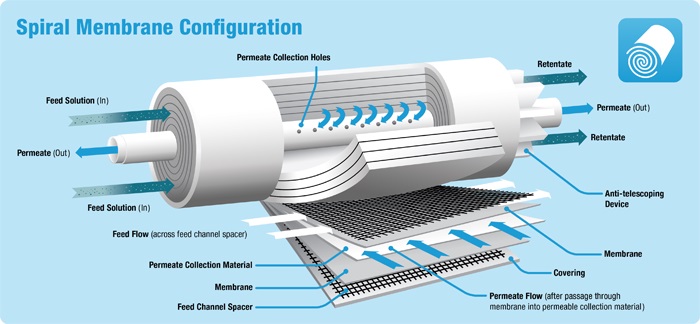
KMS produced the industry’s first spiral wound RO element. Robust, energy efficient, and economical, it is made from layers of flat-sheet membranes and feed separators wrapped around a hollow core. Feed solutions enter one end of the element, flowing under pressure through the membrane into permeate channels, spiral to the central core, and exit as permeate. This configuration offers the highest membrane-packing area with the smallest footprint.
Offered in a variety of materials, diameters, and lengths, spiral membranes have become the most prevalent of membrane configurations and are frequently used in seawater desalination, brackish water treatment, water softening and organics removal, and water reclamation and reuse. We also offer sanitary spirals for dairy and industrial biotechnology uses.
TABULAR MEMBRANES
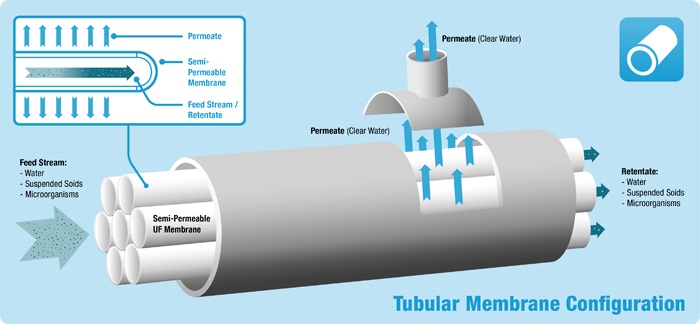
Thanks to the rugged construction of KMS tubular membranes, they can easily process high suspended solids, and concentrate product proficiently and repeatedly to high end-point concentration levels without plugging, making them ideal for recovering wastewaters, and clarifying juices.
Available in microfiltration and ultrafiltration, our tubular membranes operate in tangential, or cross-flow, design where process fluid is pumped along the membrane surface in a sweeping action. We offer a wide selection of durable options that are easy to operate and clean, serving a variety of industrial and municipal applications.

About us
Research team of Universitat de València has studied during the last two decades the following wastewater treatment processes: biological nutrient removal, primary sludge fermentation, anaerobic sludge digestion, and phosphorus recovery. During the last years, the research has been focused on the study of submerged anaerobic membrane bioreactor technology (SAnMBR) and the feasibility assessment to treat urban wastewater at ambient temperature. This research line also includes effluent post-treatment technologies and maximization of resources recovery (organic matter, nutrients and water reclamation): biological nutrient removal using methane as carbon and energy source, and nutrient recovery by microalgae cultivation (as renewable energy resource).
The research is addressed by experimental studies mainly at pilot-scale for comprehensive process modelling. Technology transference to Industry is carried out in collaboration with the UPV research group (also Associated Beneficiary of this project). Besides the consultancy assistance through different contracts, several patents have been developed: an automatic parameter calibration equipment (BioCalibra); a wastewater treatment system based on SAnMBR technology; and a nitrification-denitrification processes control system. Also in collaboration with the UPV research group, a plant wide simulator software (DESASS) has been developed. This software is continuously upgraded with the new developments made by the research group. Finally, the research group is the leader of a consortium on SAnMBR technology, titled Anaerobic Membrane Bioreactor for Recovery of Energy and Resources to achieve Sustainable Water Reuse, under the European Innovation Partnership (EIP) on Water Action Group, approved by the EC.
More info about: The CalAgua research team.
Our technology
A MISSION
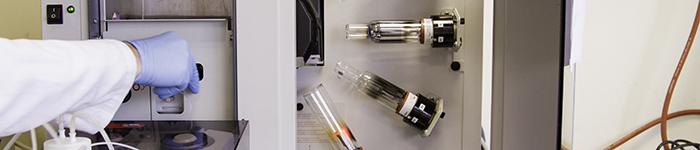
Universitat de València (UV) is a multidisciplinary university, wich conducts its research in multiple areas of knowledge. UV also offers a number of Singular Resources or Structures with highly specialized staff and equipment, to give support services to R & D taking place in public or private entities. Universitat de València’s mission is to train competent professionals at European level and encourage prestigious research with international impact contributing to the development of our society.
R+D+I
The specific area of activity related to water resources and environmental problems of water at the Universitat de València, is developed by the Departament of Chemical Engineering, this departament has differents investigation groups, one of them is CALAGUA (Quality of Water)
This research group has a main purpose, the application and the transfer of all the outcomes, the technical advices on the design, operation and optimization of the industrial or urban WWTP, to the industrial sector.

About us
Research team of Universitat Politècnica de València has been working for two decades on the integrated physical, chemical and biological processes that take place in wastewater treatment plants (WWTP), i.e. the biological removal of nutrients, primary sludge fermentation, anaerobic sludge digestion, recovery of phosphorus in the form of struvite, membrane bioreactor (MBR) applications for treating urban wastewater (Aerobic and Anaerobic MBRs), and nutrient recovery from the effluent of Anaerobic MBR systems by microalgae cultivation. These studies have been carried out focusing on process modelling and simulation, as well as control systems development for optimizing process operation.
The main aims of this research group are the transference of research results to Industry and the technical assistance on the design, operation and optimization of WWTPs. Most of the transferable results have been obtained in collaboration with the UV research group (also Associated Beneficiary of this project). This has enabled a variety of patents to be developed and marketed, including an automatic parameter calibration equipment (BioCalibra); a wastewater treatment system based on anaerobic MBR technology; and a nitrification-denitrification processes control system. Also in collaboration with the UV research group, a plant wide simulator software (DESASS) that considers all the physical, chemical and biological processes involved in a WWTP has been developed. This software is continuously upgraded with the new developments made by the research group and it is being used by several universities and companies. Finally, the research group participates in the consortium "Anaerobic Membrane Bioreactor for Recovery of Energy and Resources to achieve Sustainable Water Reuse" under the European Innovation Partnership (EIP) on Water Action Group, approved by the EC.
More info about: The CalAgua research team.
Our website
The website of the Universitat Politècnica de València is much more than the cover letter of our institution. It is an especially effective working tool and an essential aid for students. Its portals provide high quality information and a wide range of services, which are accessible from a variety of mobile devices. The result is an intuitive and functional web, universal and direct, the best reflection of what we, as a university, want to be..
Francisco J. Mora Mas - UPV Rector
Our technology
A VOCATION
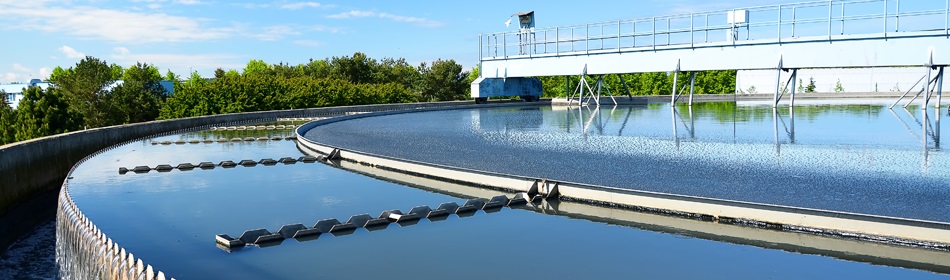
Since its inception in 1970, the Polytechnic University of Valencia has had a remarkable interest for water resources and water environment problems. This is not an accident, but a vocation, as the area of influence of this University encompasses not only the Valencia, but our neighboring areas in which the interest in hydraulic and environmental issues is great.
No doubt that our University is in the center of one of the largest water deficit areas of Spain. Water issues are key to the Valencian society from all points of view: social, economic and environmental. Therefore, we reflect the obvious need to train researchers and teachers in order to help resolve the highest level of quality. It is crucial to apply the most advanced scientifically and technologically methodologies to solve the most serious environmental problems associated with water in these regions.
R+D+I
Most professors of The Hydraulic Engineering and Environment Department of the Universitat Politècnica de València are integrated for R+D+i purposes in the Research Institute of Water and Environmental Engineering (IIAMA); this institute, with the integration of research groups from different knowledge areas and universities, has the objective of promoting the technical and scientifical research, the specialized training and technical consulting in those topics related with water.